

Anamnesis is a doctor simulator with honest diagnostics. Every patient has a real illness or injury, sometimes more than one, and almost every sign stays hidden until you ask, examine, or order a test or an X-ray. The game is in Russian, and so are the screenshots.
How to play
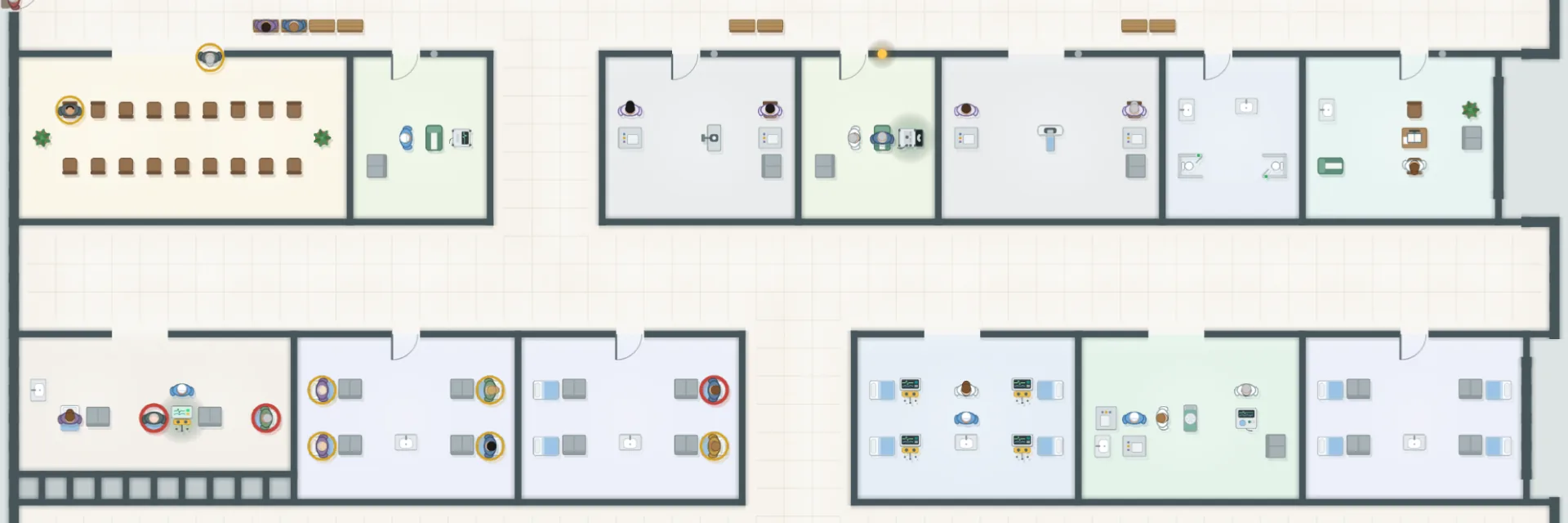
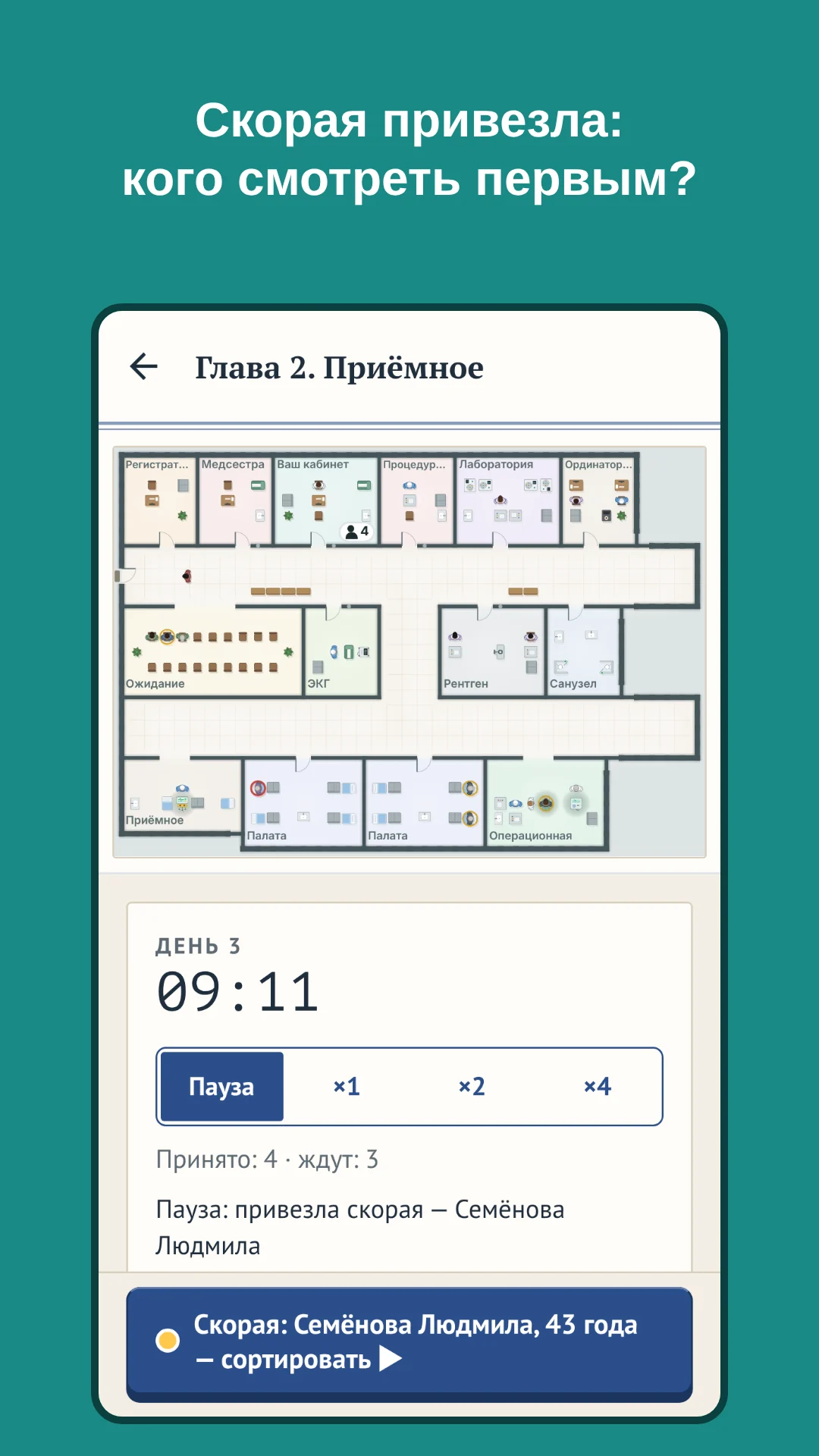
- A shift at the clinic. Patients come with and without appointments. The nurse takes temperature, pulse, blood pressure and oxygen saturation and sees urgent patients in first. The map shows who is where: at reception, in the waiting room, at the X-ray, in your office.
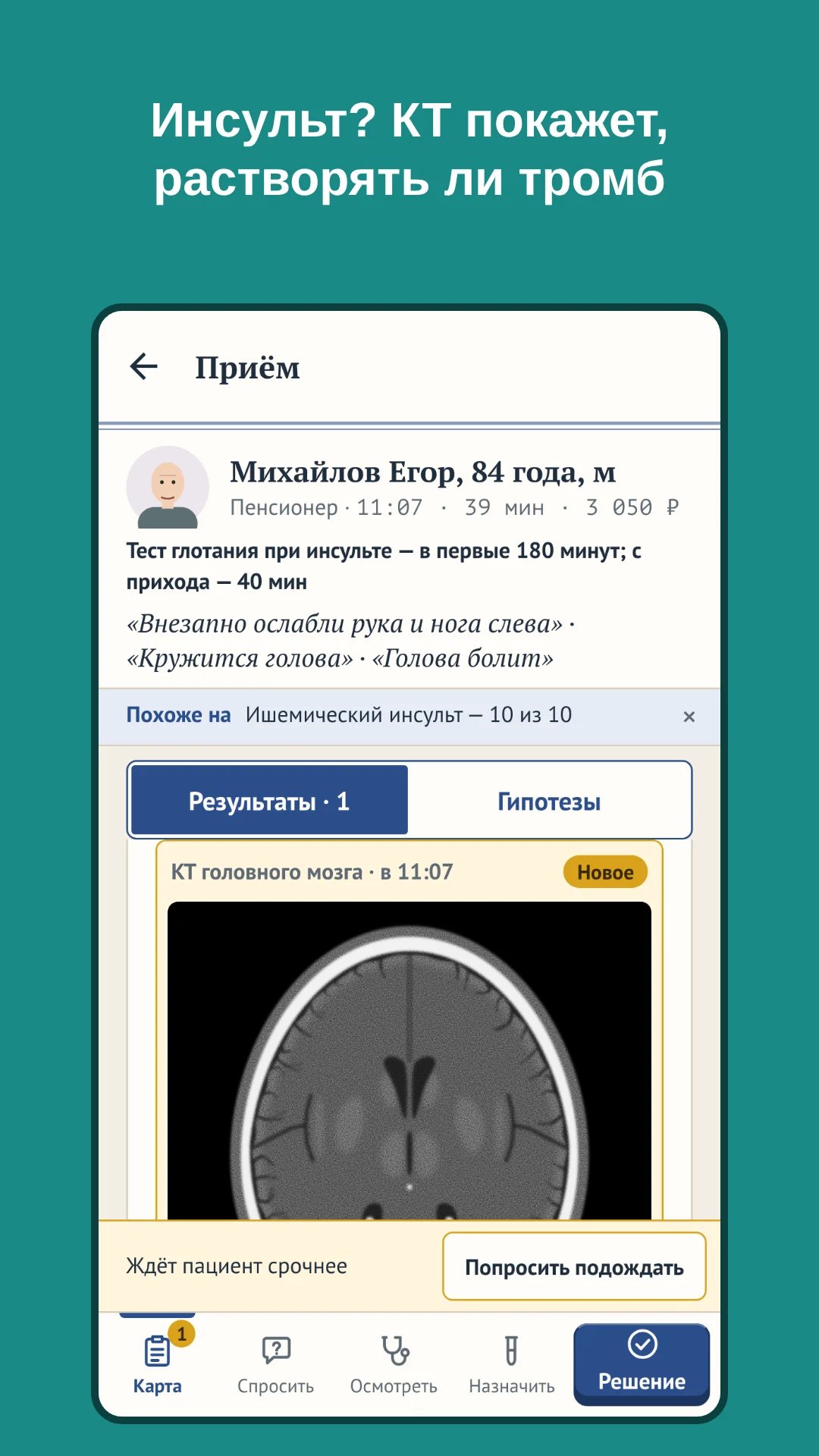
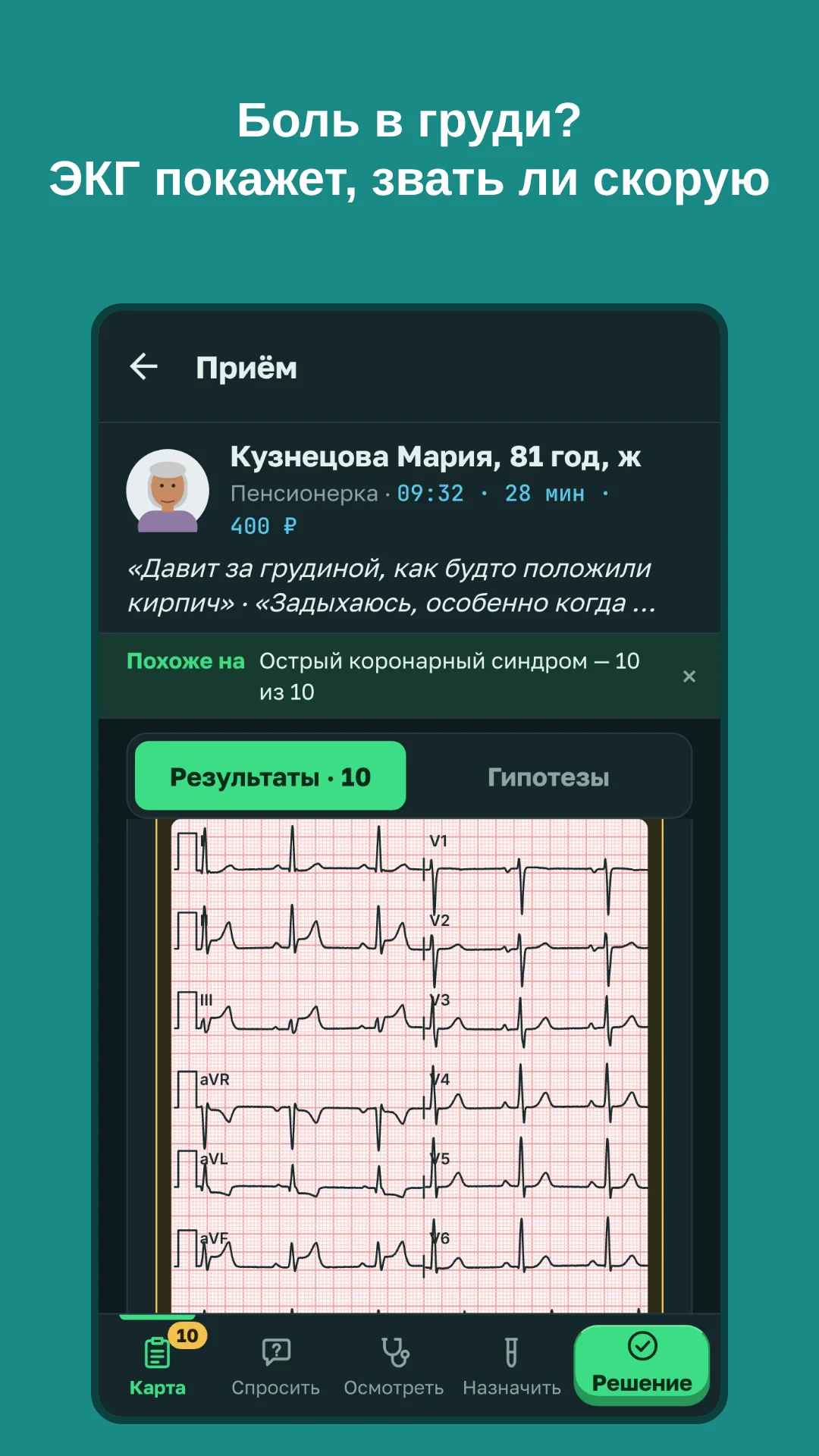
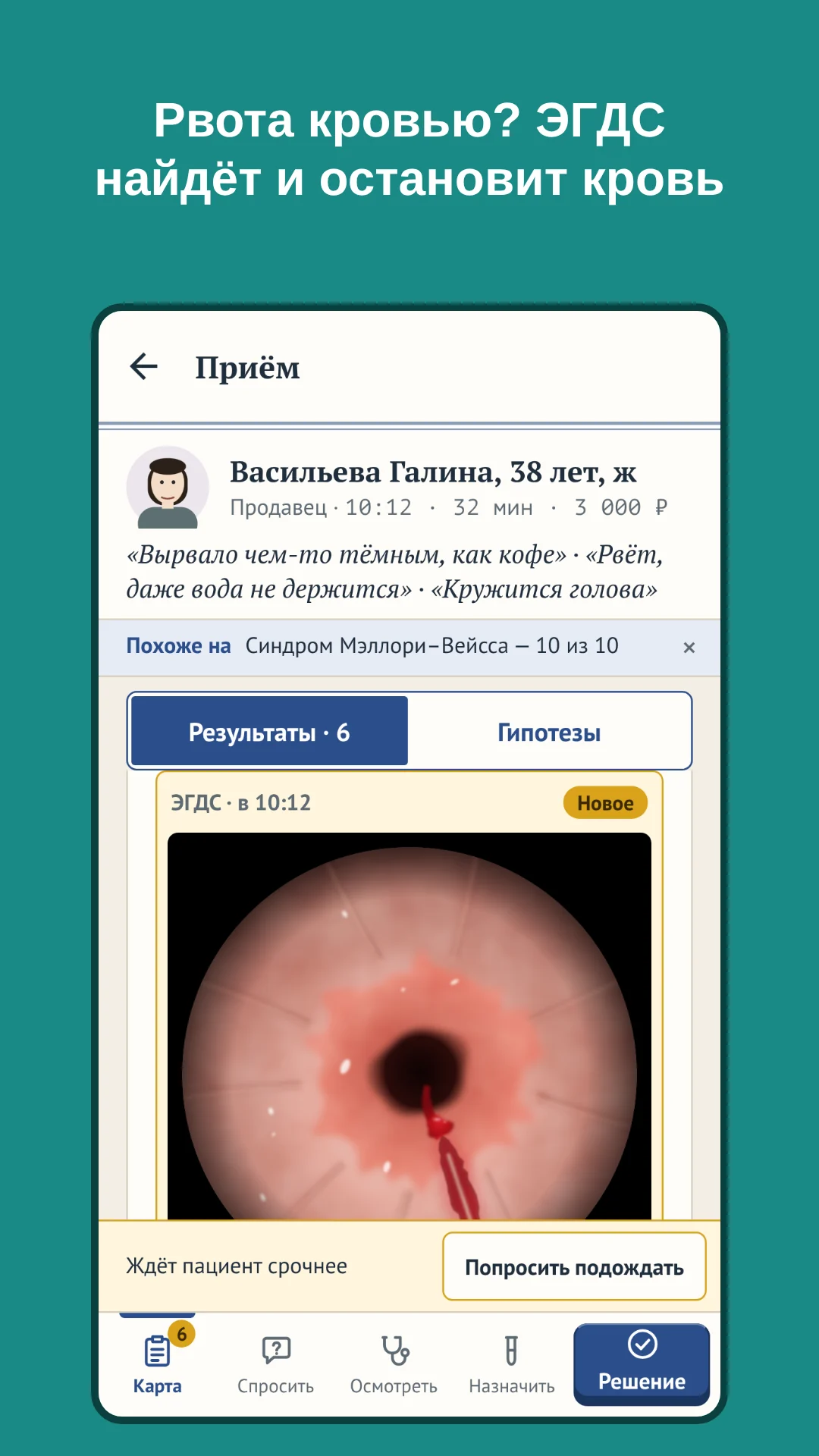
- Examination. A patient chart with tabs at the bottom, under your thumb. The history is a conversation: you ask, the patient tells. The physical exam is a tap on a body figure. Lab tests, X-rays, ECGs, ultrasound, CT, MRI and endoscopy go on a referral form — each with its own cost and time. While a test is running, you can send the patient to wait and see the next one; those who wait too long leave.
- Hypotheses. The patient chart holds a log of results and a hypothesis board: your own differential, and for each hypothesis what speaks for it, what speaks against it, what is still unchecked and what would confirm it.
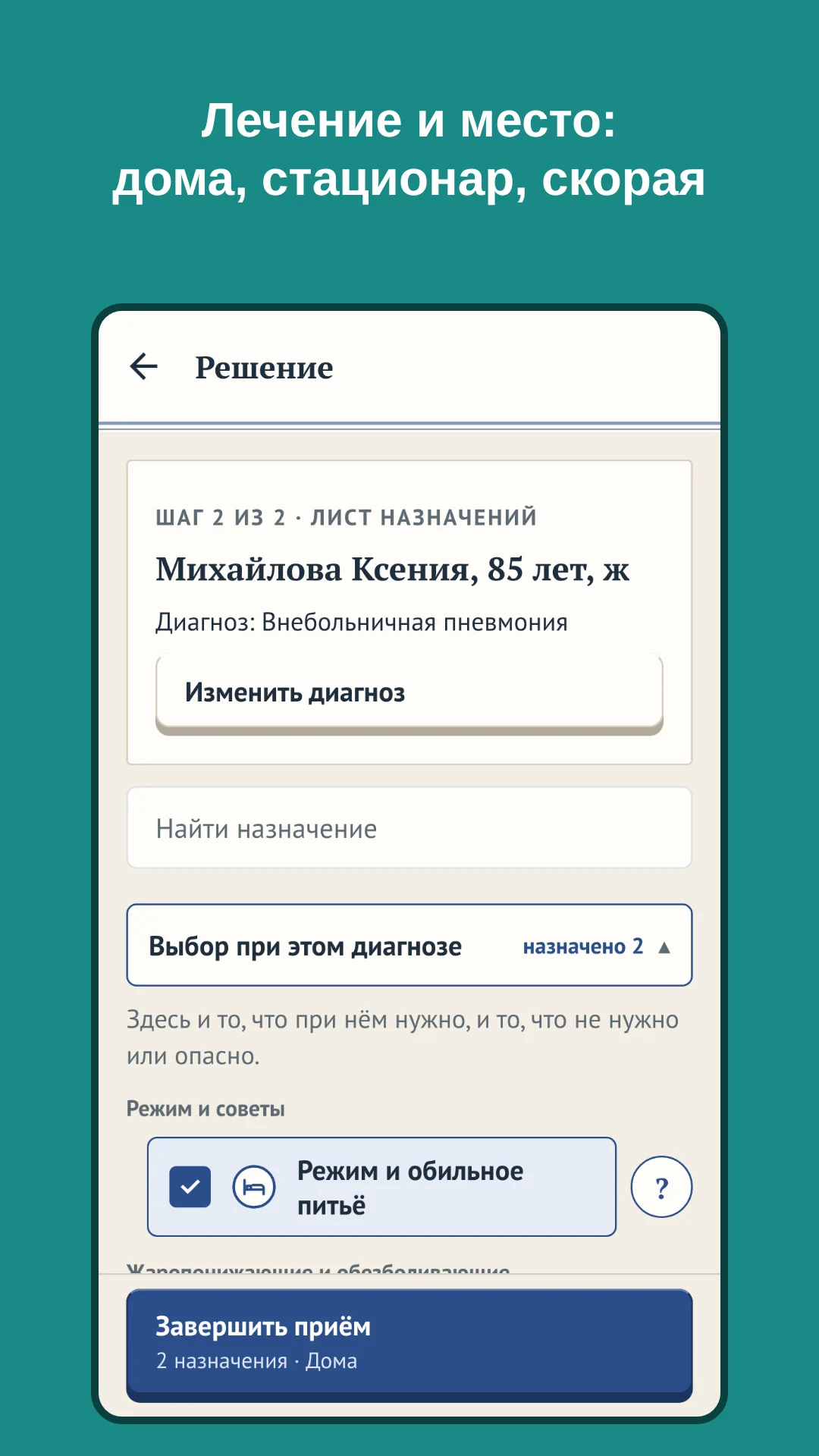
- Decision. A diagnosis, a treatment sheet and where to treat: at home, on a ward or in the operating room — or, if needed, a referral to another hospital or an ambulance.
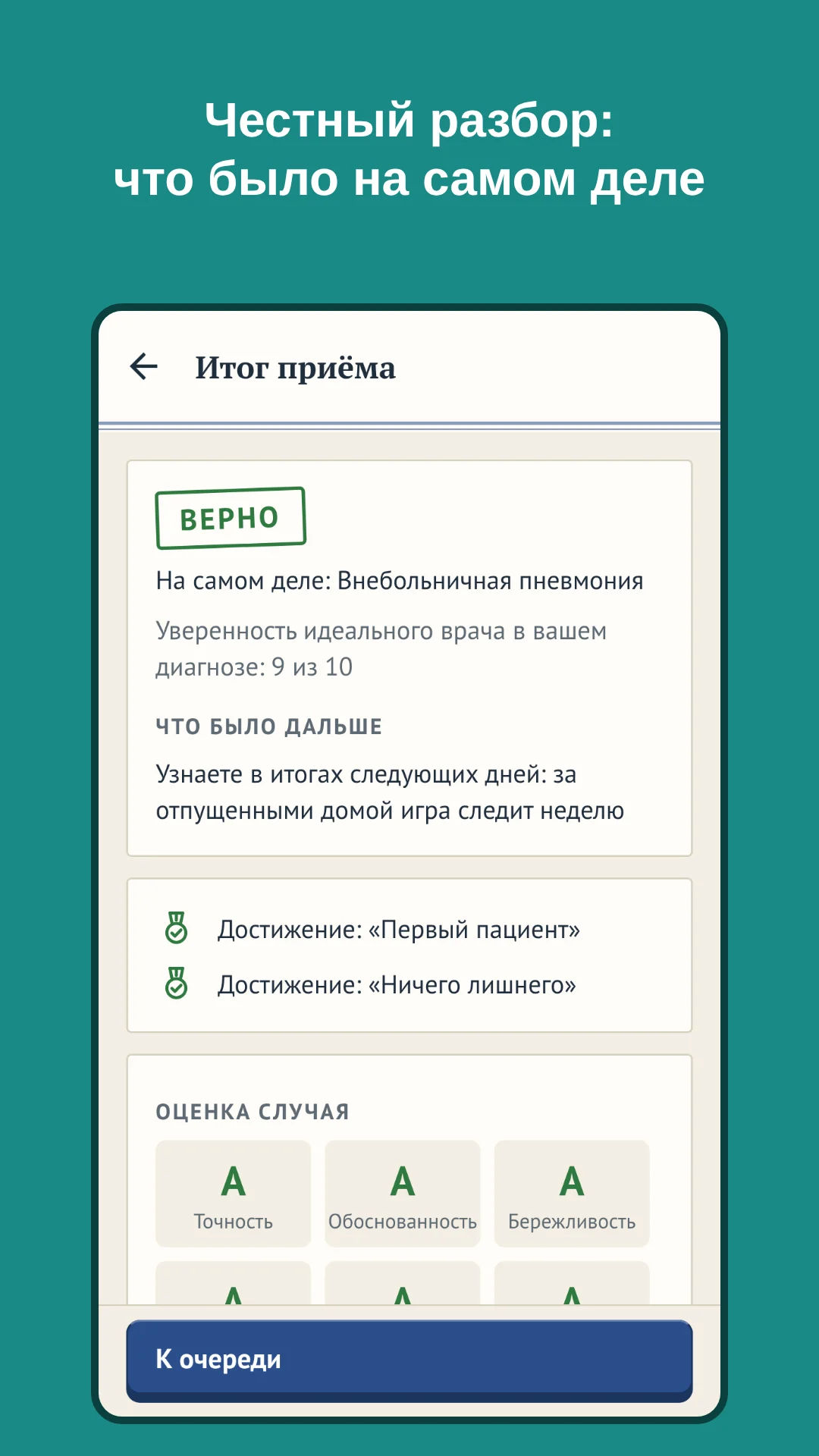
- Review. What it really was, a score for accuracy, justification, thrift and safety, and how an experienced doctor would have reasoned. Patients sent home sometimes get worse and come back, and the end-of-day summary tells you what happened to earlier patients.
- Campaign. A young doctor at a village clinic, and then at a district hospital with an emergency department, wards and an operating room, where a vascular unit with a CT room and an intensive care ward opens, and at a city hospital with a ventilator ICU, an infectious diseases unit, endoscopy and specialist doctors. The first shift is with a mentor; after that come letters and tasks without deadlines, and at the end, a look back at the whole career.
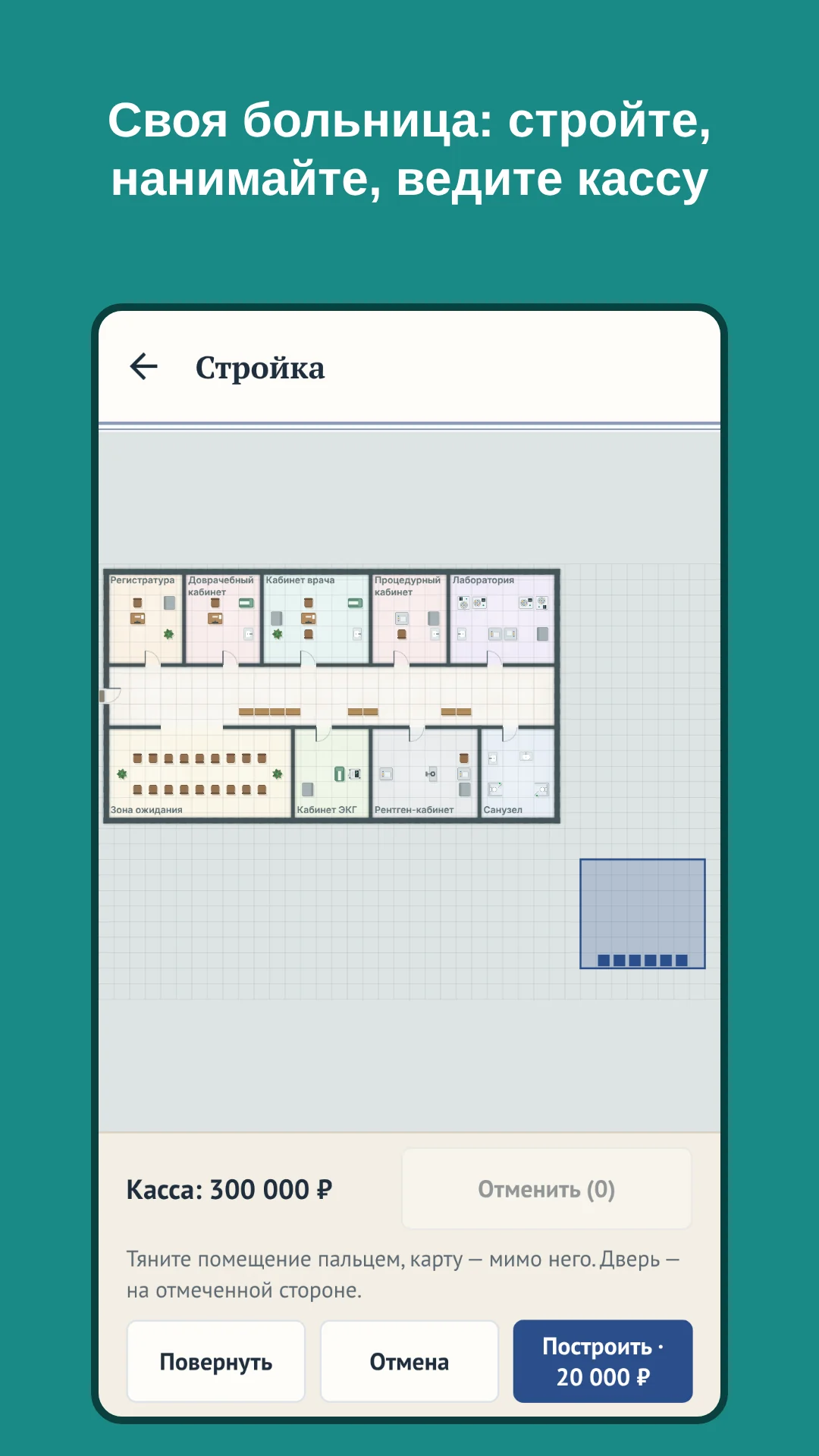
- Your own hospital. Offices, a lab, X-ray, ultrasound, CT, MRI and endoscopy rooms, an emergency department, wards, isolation boxes and an operating room, hiring, the cash desk. Doctors you hire see patients on their own, specialists have their own appointments, and new patients from the disease groups you pick are left for you. Insurance pays for a justified diagnosis and for tests that were indicated. The end-of-day summary shows where patients waited: for each place, how many went through, how long they waited and how long it was busy, with the bottleneck first.
- Emergency department. The ambulance brings in the seriously ill, and urgency is checked against the NEWS2 score. Seriously ill patients in the exam bay get first measures, from oxygen to a pressure dressing: the bay nurse gives them, and the bedside monitor shows what got worse. Without the measure they need, a seriously ill patient gets worse every 20–40 minutes, and a cardiac arrest calls a code blue: the team runs to the bed. You do a ward round every morning and discharge patients when they are better; a surgical team works in the operating room — and the longer an appendicitis or a perforated ulcer waits, the more dangerous it gets.
- Four difficulty levels. Trainee: “Looks like” hints, what relates to the complaint comes first in questions, examination and tests, and the review is gentler. Student: hints, and tests never err. Resident: up to three “Looks like” conditions with confidence in words, and tests sometimes err. Doctor: no hints, and tests sometimes err, as in real life.
What’s inside
The game’s medical database holds over 120 illnesses, injuries and poisonings, and it grows with every version. Patients come to you with over 110 conditions and injuries; the rest are poisonings and chronic illnesses that run in the background of the main one.
Clinic
- Conditions a general practitioner sees: from colds and flu to pneumonia, angina, heart attack, hypertensive crisis, pericarditis and acute heart failure.
- Rhythm problems: atrial fibrillation, tachycardias, heart block.
- Pulmonary embolism, hypoglycaemia and diabetic ketoacidosis, nosebleeds, hives and anaphylactic shock.
Emergency department and surgery
- Surgical conditions: from biliary colic to a perforated ulcer, bowel obstruction, deep vein thrombosis and acute ischaemia of the leg.
- Injuries: fractures, knee ligament tears, a torn calf muscle, hand and scalp wounds, burns, chest trauma, concussion.
- Wounds and burns as in a real emergency department: stitch now or delay the stitches, check the finger tendons, measure a burn with the patient’s palms. Tetanus shots by vaccination records, and after a dog bite, a rabies vaccine with immunoglobulin.
- Operations — from appendectomy to hip replacement.
Stroke unit
- Ischaemic stroke: thrombolysis within 4.5 hours, and the window closes while the work-up goes on.
- Brain haemorrhage, transient ischaemic attack, aortic dissection, pulmonary embolism — each with its own scores, its own scans and its own deadline.
- A drooping face is not always a stroke: it may be Bell’s palsy, and then no CT is needed.
- Seizures and status epilepticus: an anticonvulsant within 5 minutes.
Infectious diseases ward
- Gut infections, meningococcal disease, herpes simplex encephalitis.
- After a tick bite — tick-borne encephalitis and Lyme disease.
- Botulism after home-canned food, viral hepatitis A and B, haemorrhagic fever with renal syndrome.
- An infectious patient never goes to a shared ward: there are isolation rooms for that.
Images and tests
- The images are drawn by the program and differ for every patient: chest, abdominal and bone X-rays, abdominal, vein and artery ultrasound, 12-lead ECGs, head CT and MRI, spine MRI.
- Decision rules from clinical guidelines: whether an ankle, foot or knee X-ray is needed, whether a CT scan is needed after a blow to the head, whether a leg vein ultrasound is needed for leg pain.
- Signs don’t always show up and tests are sometimes wrong — as in real life. A diagnosis is a probability, and the review shows how sure an experienced doctor would have been.
Encyclopedia, profile and modes
- “What is this?” for every sign and test in plain words, and more in the in-game encyclopedia. From a condition’s article you can work through a case — see one such patient.
- A doctor profile: specialties with levels and small skills, practice totals, an archive of visits with reviews, and achievements — no deadlines and no streaks.
- A “Shift” at a hospital of your choice and a “Case of the day” — one patient a day, the same for everyone; any of the last 30 days can be played at any time.
- Challenges — a shift with a condition: no history taking, no tests or scans, or no more than 1,500 ₽ of tests per patient. Week-long scenarios — five shifts with a special patient flow and a goal of their own: “Winter flu”, “The hospital next door has closed”, “The X-ray is broken”.
- Two themes: the light “Chart” — paper and blue ink — and the dark “Monitor”. Or follow the phone.
- Progress moves to another phone as a file.
Questions
How much does Anamnesis cost?
It is free. There are no ads, purchases or subscriptions.
Do I need the internet?
No. The game works offline and sends nothing anywhere — it doesn’t even have permission to access the network. Saves stay on the phone; to move them to another phone, use a file — the transfer screen in Settings.
Is this a medical app? Can I treat myself with it?
No. Anamnesis is a game, not a medical device, and it does not replace a doctor. Diseases, tests and treatment follow clinical guidelines but are simplified for the game, and the medical articles are still drafts. If you or someone close to you feels unwell, see a doctor; in an emergency call 112 (103 is the ambulance in Russia).
What age is it for?
16+. The game has serious illnesses, injuries, poisonings and patient deaths — not graphic, but not played down either. If you’d rather not lose patients, turn on soft mode in Settings: instead of dying, a patient is transferred to the regional hospital in a critical condition.
Do I need medical training to play?
No. Every sign, test and disease is explained in plain words: tap “?” for a short note, and read more in the in-game encyclopedia. The first campaign shift is with a mentor, and the easier difficulty levels hint at what the illness looks like.
How do the difficulty levels differ?
Trainee: hints, and what matters for the complaint comes first. Student: a “looks like” hint with frequencies; tests and examination never err. Resident: up to three diseases in that hint, confidence in words; tests sometimes err. Doctor: no hints; tests and examination sometimes err, as in real life.
What is the case of the day?
One patient a day, the same for every player. You can play any of the last 30 days; the first attempt counts, and afterwards there is a review of what it really was.
Can I build my own hospital?
Yes. In the campaign the hospital grows chapter by chapter, and after chapter 2 the sandbox opens: your own hospital on an empty plot or from a ready clinic — offices, a lab, X-ray, ultrasound, CT, wards, an operating room, hiring doctors and running the budget.
How many chapters are there, and how does the campaign end?
Four chapters: from a village clinic to a city hospital with intensive care. Each has letters and tasks without deadlines; after chapter 4 comes a look back at the whole career and a letter from the mentor. You can run three careers, each at its own difficulty, and keep working in the hospital after the finale.
Found a bug or have an idea — where do I write?
The bug report in Settings gathers the version, phone and the day’s log, and you send it yourself. Or write from the About screen. Email: support@gornitsa.games. We read RuStore reviews too.
What’s next
The game is out on RuStore for Android, in Russian for now — the button is at the top of the page. Coming up: new campaign chapters. Questions: support@gornitsa.games.